


We tested this with two fictional, non-combat quests. The task allowed creative connective details but required the names, objects, locations and timing constraints to remain consistent.
Give the quest a short list of fixed facts
The first brief used Nora, a blue key in a garden and a return before the library closed. Orlino produced three beats: request, search and return. It kept the blue key and the deadline, then added optional scene details and dialogue around them.
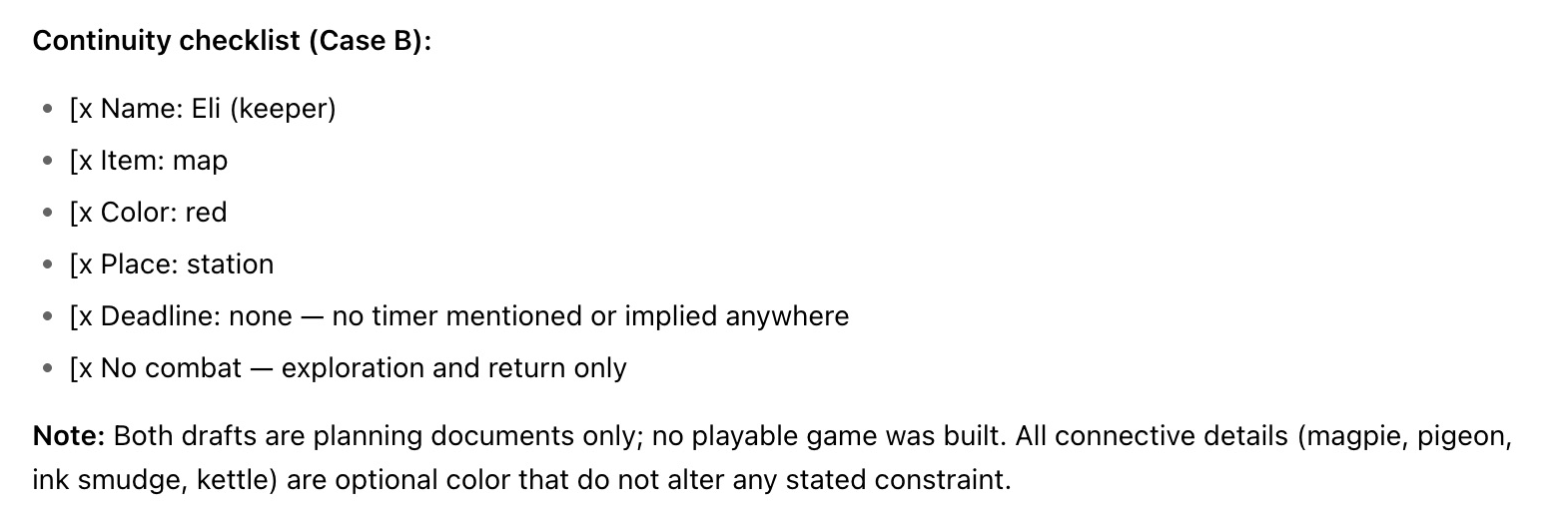
The second case changed the keeper to Eli, the object to a red map and the location to a station. It had no deadline. The new outline retained that untimed structure and used exploration rather than combat. Its optional environmental clues were creative additions, not details claimed to come from the original brief.
One optional line for Eli was: “Red map. Ink like a poppy. It'll turn up”. The dialogue was invented for the scene; the red map, Eli and the station came from the brief. We checked those fixed details against the continuity list.
Separate constraints from creative freedom
Open a new task and select Game Narrative Designer. We used GPT-5.6-Sol in Orlino desktop 0.0.6.
Draft three quest beats and a short optional dialogue exchange from this fictional brief: [facts]. Preserve character names, object colors, locations and deadlines exactly. No combat. Creative connective details are allowed; label them as additions. End with a continuity checklist. Reply in English in chat. Do not claim to build a playable game.If a mechanic is fixed, put it in the constraint list. If the writer can invent it, say so. That distinction gives the model useful freedom without making every detail equally negotiable.
Review the additions as design proposals
Check whether a suggested clue changes the required route or introduces a new obstacle. Review any reward or retry idea separately from the story facts. The outline gives a narrative designer material to choose from; implementation still needs its own design and playtesting.
These were narrative outlines in chat. Implementing scenes, sound or a playable build would be a separate task.
Outline a quest in Orlino with a few fixed facts and an explicit area for invention.
About this walkthrough
Published by Orlino Editorial from two recorded fictional chat cases in Orlino 0.0.6 with GPT-5.6-Sol on October 21, 2026. The starting prompt is adaptable. These examples establish only the described scope, not general model reliability. Screenshot text is unchanged; account controls are outside the crop. See our editorial process.
Try your next task in Orlino.
Bring your notes, files, and questions to Orlino. Choose the app for your device.
Keep reading
Draft a short fiction scene within a fixed word range
Draft a short fiction scene in Orlino with fixed characters, objects and timing constraints, then check continuity and the requested word range.
Read article Work & productivityCheck game scoring examples before expanding the rules
Check fictional game scoring examples in Orlino with visible running totals, including negative points, while keeping missing bonus and tie rules unknown.
Read article