


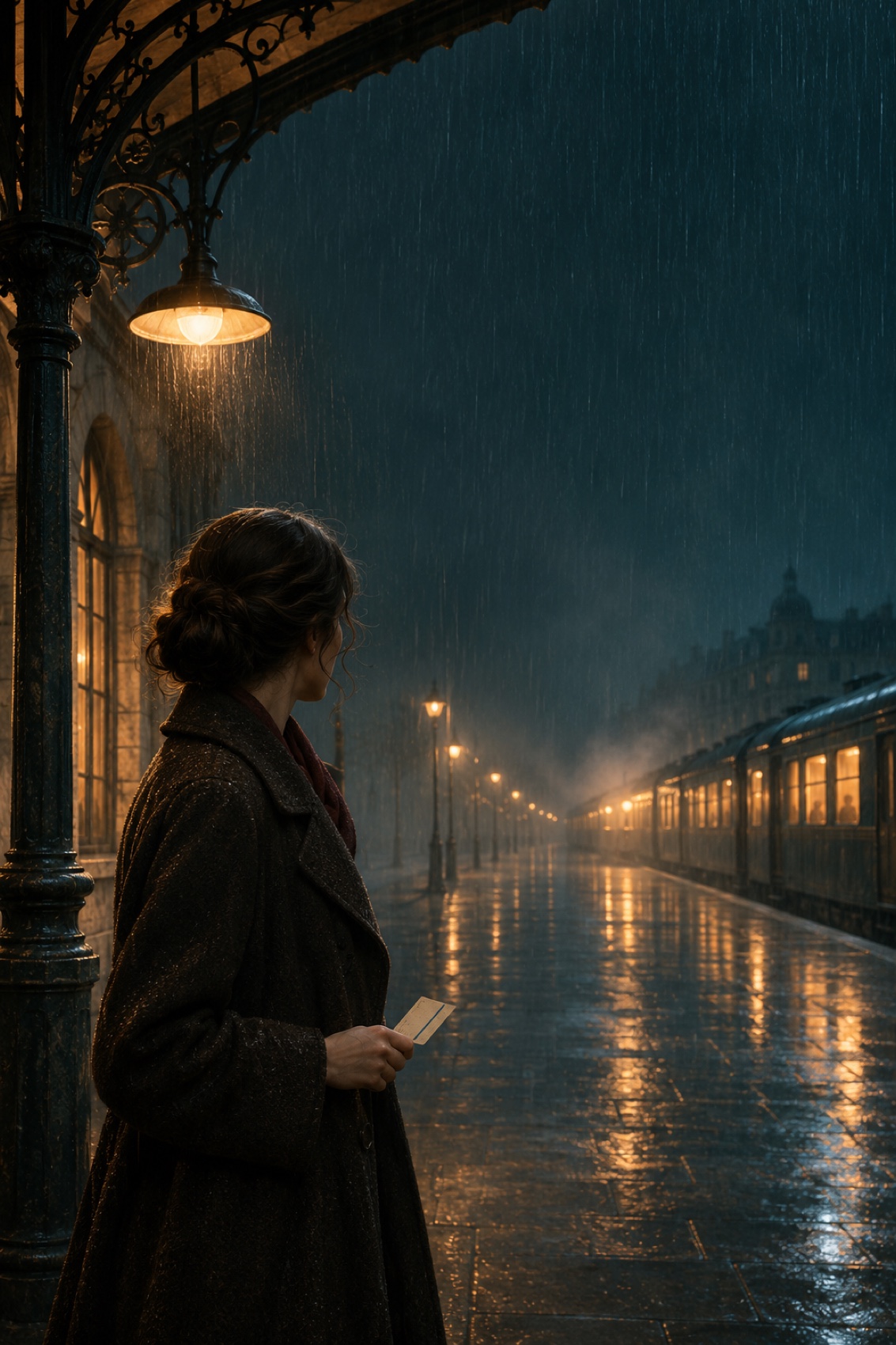
The Last Train to Saint Oran
The ticket was warm when Mara found it, although the archive had been cold since October.
Saint Oran, one way. Tomorrow, 11:47 p.m. The name on the back belonged to her mother.
For twenty years Mara had sorted other people’s departures into acid-free boxes. There were tickets issued during the flood, a timetable printed with the wrong month, a conductor’s apology to a woman whose cello had arrived in another country. Every journey left some small mistake behind. Her mother’s had left none.
She held the ticket beneath the desk lamp. Across the return address, a blue thread had been pressed into the paper. The same thread her mother used to mend the cuffs of a coat too large for her, always leaving one stitch visible. A repair, she said, should not pretend nothing happened.
Mara’s father had told her that her mother took the northern train. He had said it so often that north became a direction she avoided, even inside a room. But Saint Oran was south. Beyond it the rails ended at a winter harbour.
At home she opened the cupboard he had asked her never to empty. Behind his folded shirts lay a bundle of unsent letters, tied with blue wool. The first began, I was wrong to tell her you left. The last had no date and only one line: I do not know how to give her back the choice I took away.
At 11:32 the next evening, Mara stood on platform four with the ticket and a coat she had finally learned to mend herself. The departure board was dark. A porter swept the same clean patch of stone.
“Saint Oran?” she asked.
“Not on the board,” he said. “That doesn’t always mean it isn’t coming.”
She waited. Across the tracks, a station clock struck eleven, then stopped. Somewhere beyond the signal, a light opened in the mist. It did not rush towards her. It seemed to wait for her to notice it.
A woman stepped from the last carriage. She was older than the photograph on Mara’s desk and younger than the woman Mara had imagined becoming. Her coat was missing a button. The cuff showed one deliberate blue stitch.
Mara had rehearsed a hundred questions. Why did you leave? Why didn’t you come back? Why was I not enough? Each one had assumed an answer before it was asked.
Instead she held up the letters.
Her mother looked at them for a long time. “Did he ever send one?”
“No.”
Neither of them moved. Behind the woman, the carriage windows were warm and full of people reading. Somewhere a teaspoon rang against a cup.
“There’s a place by the harbour,” her mother said. “It opens early. We could begin there.”
Mara turned the ticket over. Under the name, in handwriting she had not recognised until now, was a blank line. Not a return date. A place to write the next destination.
She stepped aboard, carrying the questions she still intended to ask.