


Code migration is a compatibility problem before it is a code-generation problem. A replacement API can compile while changing retry behavior, error handling, serialization, or ordering. A useful Gemini 4 workflow makes those contracts explicit and checks the resulting patch against them.
This guide develops a hypothetical migration from a legacy HTTP client to a maintained client inside one service. It is a practical evaluation method, rather than a report that Gemini completed this migration. The exact model, tool access, repository state, and execution evidence should be recorded when you run your own trial.
For specifications and access considerations, see the Gemini 4 model guide.
Write a migration contract
Name the current implementation, the target implementation, and the observable behavior that must remain stable. For the HTTP-client example, that includes timeouts, redirect policy, headers, response parsing, and the exception types seen by callers. “Replace the library” is an implementation action; the contract explains what a successful replacement means.
Identify intended behavior changes separately. You might deliberately tighten a timeout or stop following redirects, but those decisions should not appear accidentally inside a dependency update. Reviewers need to distinguish compatibility work from a product or security policy change.
Keep the contract close to the code change so that the final review can compare them. A short document with concrete examples is often more useful than a broad statement that the new library is equivalent. Include a rollback condition and the tests that should trigger it.
Consult the exact target documentation
Use the official documentation for the target library and version actually selected by the project. A remembered method name may belong to another release. Ask the model to connect each proposed API replacement with the version-specific reference and the current code that uses it.
Do not silently upgrade unrelated dependencies to make an example compile. If the target version requires a runtime change, surface that dependency and explain the alternatives. A narrow migration is easier to assess when its environmental requirements are visible.
Gemini’s own model references describe supported tools and technical capabilities, but they do not replace documentation for the library being migrated. The Gemini 4 overview explains the distinction between the model and its surrounding environment. In a real migration, preserve the relevant library links in the task packet.
If compatibility depends on several documents, the Gemini 4 research workflow can organize their evidence and conflicts.
Ask for a proposal before a broad patch
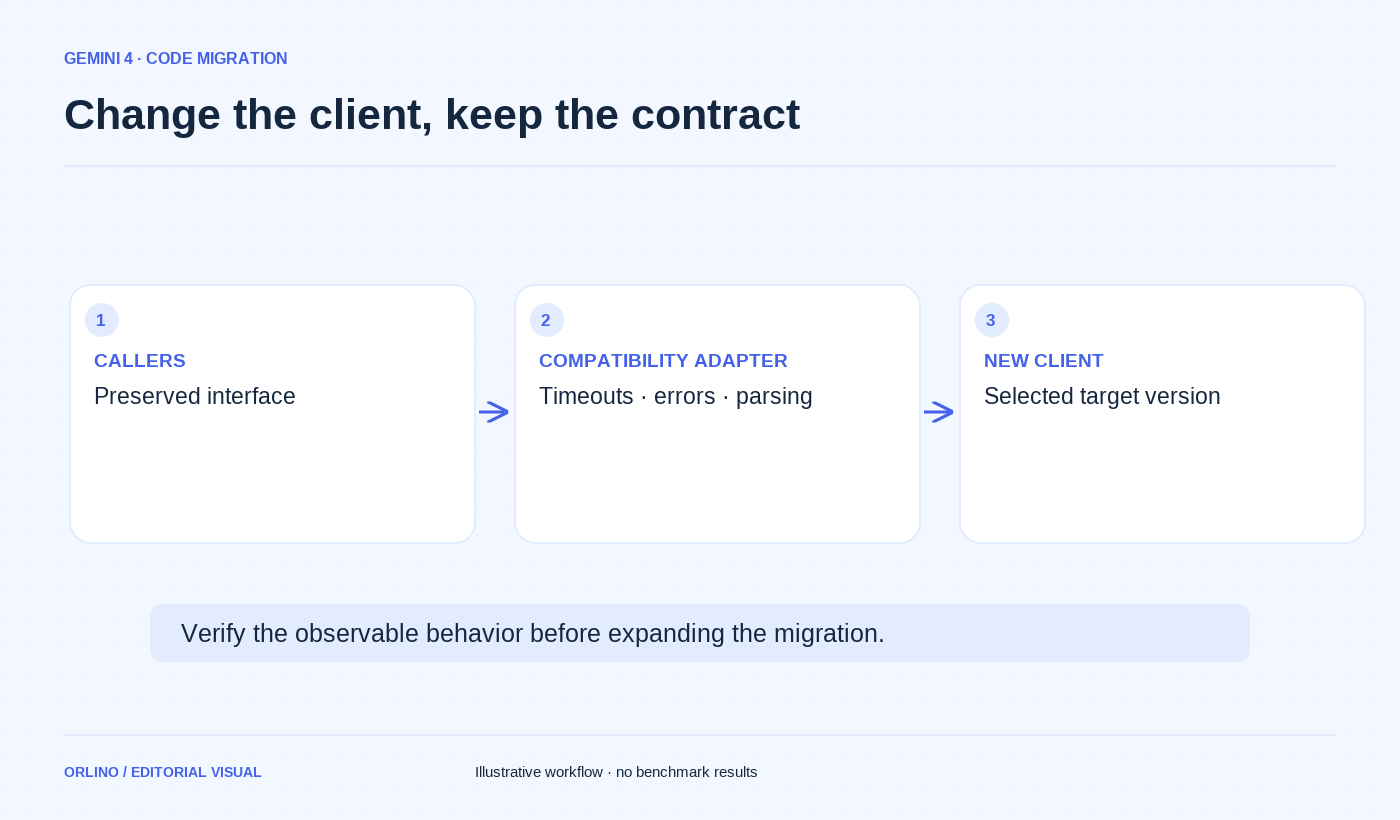
A proposal should identify the compatibility boundary and the smallest implementation that tests it. In the HTTP example, an adapter can preserve the service’s existing interface while swapping the underlying client. This makes behavior easier to compare and reduces the number of callers changed at once.
The adapter is an option to evaluate, rather than a universal rule. If the old wrapper is itself the source of the problem, preserving it may retain unnecessary complexity. Ask for a concrete reason for the chosen boundary and the tradeoff it introduces.
A good proposal also names uncertainty. For example, the old client may retry connection failures under undocumented conditions. The next step should be a targeted investigation or test, rather than a confident assertion that the new default is equivalent. Resolve the behavior that matters before expanding the patch.
Use a migration prompt with behavioral checks
The prompt should connect the target change with the contract and require actual verification evidence. Give the model the repository’s own contribution instructions and existing test commands. Avoid inventing a parallel test setup when the project already provides a meaningful one.
Migrate the reporting service's HTTP wrapper to the selected client version.
Preserve the documented caller interface and timeout behavior.
First map imports, wrappers, configuration, and relevant tests.
Propose the smallest compatibility boundary before broad edits.
Add checks for timeout, retry, error mapping, and response parsing.
Report commands actually run and their outcomes.
Do not modify unrelated dependencies or production configuration.
Adapt the boundaries to the authorization and environment of the task. If a migration requires a configuration change, prepare it explicitly instead of hiding it in a general implementation request. The final patch should make the operational consequence understandable to a reviewer.
Stage the implementation around one complete path
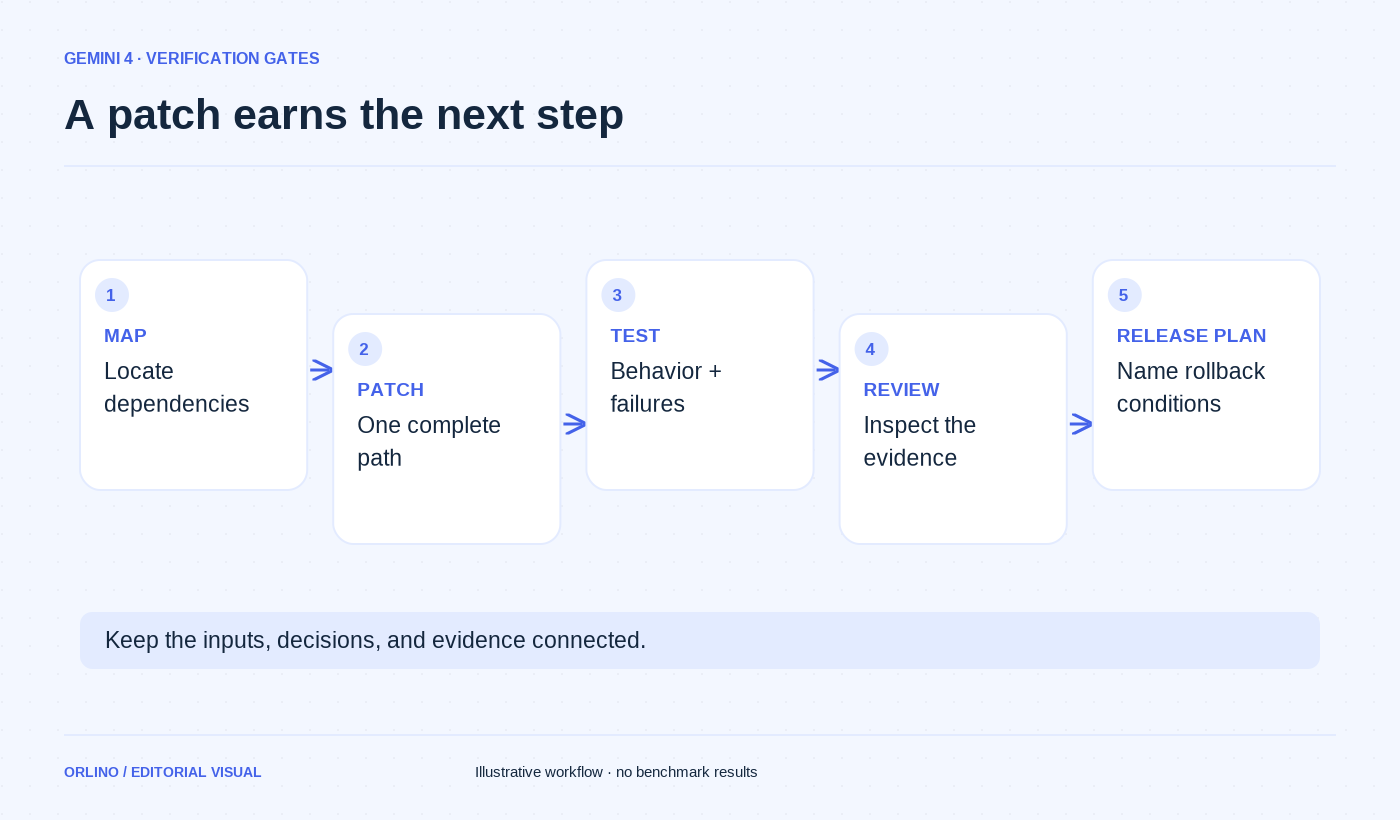
Choose one representative call path and migrate it end to end. Verify request construction, response handling, and the failure behavior relevant to that path. This produces a useful vertical slice and reveals whether the proposed adapter boundary works in practice.
Expand only after that slice provides evidence. Several simultaneous replacements can make a failure hard to localize: the problem may lie in defaults, environment, serialization, or a caller assumption. A staged patch gives the reviewer a clearer connection between the change and its effect.
Keep generated or mechanical edits separate where practical. A lock-file update can be necessary, but it should not conceal unrelated source changes. Review the diff after each meaningful phase and remove accidental formatting churn that makes the compatibility change harder to inspect.
The Gemini 4 pricing guide helps budget for the complete migration trial, including correction requests.
Test the failures that distinguish the clients
A successful request is necessary but often insufficient. For an HTTP migration, inspect timeout handling, connection failures, response errors, cancellation, redirects, and retry conditions that matter to the service. Choose tests from the actual contract rather than a generic exhaustive checklist.
A particularly important case is retrying a non-idempotent operation. If the service sends a payment-like action, a repeated request can have a different consequence from retrying a read. The test should demonstrate the intended behavior under a realistic failure boundary, not merely assert that a retry helper was called.
Use controlled responses or a local test server when the project’s test environment supports it. Avoid tests that depend on a public endpoint remaining available. When a relevant integration check cannot run, record the limitation and identify what still needs to be verified before release.
Separate model output from executed evidence
A generated test file is an artifact, not proof that the test passed. Record the actual command, environment, and result. Inspect whether the command selected the intended tests and whether warnings or skips affect the conclusion.
If execution fails because of a missing environment dependency, preserve the distinction between an unverified patch and a proven defect. Continue with useful independent checks where possible, but do not convert an unavailable integration check into a pass. The final handoff should make this state clear.
The same discipline applies to performance. A model may suggest that a new library is faster, but that is not a measured result for your service. If latency or memory is part of the migration contract, define a suitable measurement and report the observed conditions and values.
Compare Argon and Carbon on the difficult part
A model comparison can focus on the part of the migration that carries uncertainty: mapping subtle error behavior, identifying a retry risk, or proposing a compatible adapter. Use the same repository state and task packet so that the comparison remains interpretable.
Google positions Argon for efficiency and Carbon for demanding technical reasoning. Treat this as a starting hypothesis. The Carbon vs Argon guide explains how to compare accepted results, corrections, and configuration rather than deciding from the family label alone.
Include total usage and review effort if cost matters. The Gemini 4 pricing guide shows how token rates and task usage interact. A cheaper first request can become a more expensive migration if it needs substantial repair.
Prepare release and rollback notes
The handoff should lead with the resulting behavior and any deliberate changes. Then describe the adapter or replacement approach, the tests actually run, and the remaining checks. Keep the migration contract visible so that a reviewer can assess completion without reconstructing the conversation.
Name the rollback artifact or procedure appropriate to the project. Reverting code may be straightforward for a library swap, while a migration that also changes stored data can require a different recovery plan. Do not imply that one generic rollback procedure covers both.
A completed local patch does not by itself establish a successful production rollout. State the current delivery state and the next authorized action. If deployment belongs to a separate process, prepare the information that process needs rather than treating the local test run as evidence of live behavior.
Conclusion
Use Gemini 4 for code migration by defining compatibility first, mapping dependencies, and staging a small patch with behavioral checks. Preserve actual execution evidence and make unresolved limits visible in the handoff. The strongest result is a change a reviewer can understand, verify, and reverse under the project’s own process.
FAQ
Can Gemini 4 migrate an entire repository?
It can be evaluated on repository migration work when the application provides the necessary tools and access. Begin with a bounded path and clear acceptance criteria before expanding the scope.
Should I start with Argon or Carbon?
Choose a representative migration problem and compare the accepted result and review effort. Provider positioning can guide the first trial, but it does not establish the best choice for every repository.
What belongs in a migration contract?
Include preserved behavior, deliberate changes, environmental requirements, acceptance checks, and rollback conditions. Name concrete examples such as timeout and exception behavior.
Is compiling enough to validate a migration?
No. Compilation does not establish that retries, parsing, cancellation, or error handling remain compatible. Test the behavioral boundaries that matter to the service.
Should every call site change at once?
That depends on the architecture, but a staged representative path often makes failures easier to diagnose. Explain the boundary and expand after the initial evidence supports it.
What if the integration environment is unavailable?
Record the unrun check and continue independent verification where possible. Do not report an integration result that the environment did not produce.
What should the final report contain?
Describe resulting behavior, changed files, actual check results, deliberate deviations, unresolved limits, and the next release step. Keep enough evidence for another developer to continue the work.