


A long AI assignment becomes difficult when the task changes while the model is working. Files change, a tool fails, a new requirement arrives, or a plausible assumption turns out to be wrong. A useful workflow makes those changes visible before they spread into the final deliverable.
Claude Fable 5.2 is positioned for demanding reasoning and long-horizon agentic work in Anthropic’s model overview. That positioning is a reason to evaluate it for sustained assignments. It does not remove the need to define scope, permissions, evidence, and a stopping point. This guide develops a practical checkpoint system around a hypothetical application modernization task; it reports a method, rather than a completed performance test.
For specifications and access considerations, see the Fable 5.2 model guide.
Define a deliverable that can survive a handoff
Start by naming the artifact someone will inspect. “Modernize the reporting system” is too broad. “Replace the legacy date parser in the reporting service while preserving the documented timezone behavior” gives the work a boundary. Add the affected files, supported environments, and required examples of behavior.
A task brief should also name work that requires a separate decision. Changing a dependency version, deleting a compatibility branch, or altering a public response field can affect other teams. Record those decisions as explicit boundaries in the brief. An agent can investigate them and prepare options without treating a discovered opportunity as an instruction to expand the assignment.
The acceptance criteria should describe observable behavior. For example: an empty date remains empty; invalid dates return the existing validation error; daylight-saving transitions preserve the agreed local reporting day. These statements help a reviewer assess a finished change even if the original author is unavailable. They also give the model a consistent target after interruptions.
Build a task ledger before execution
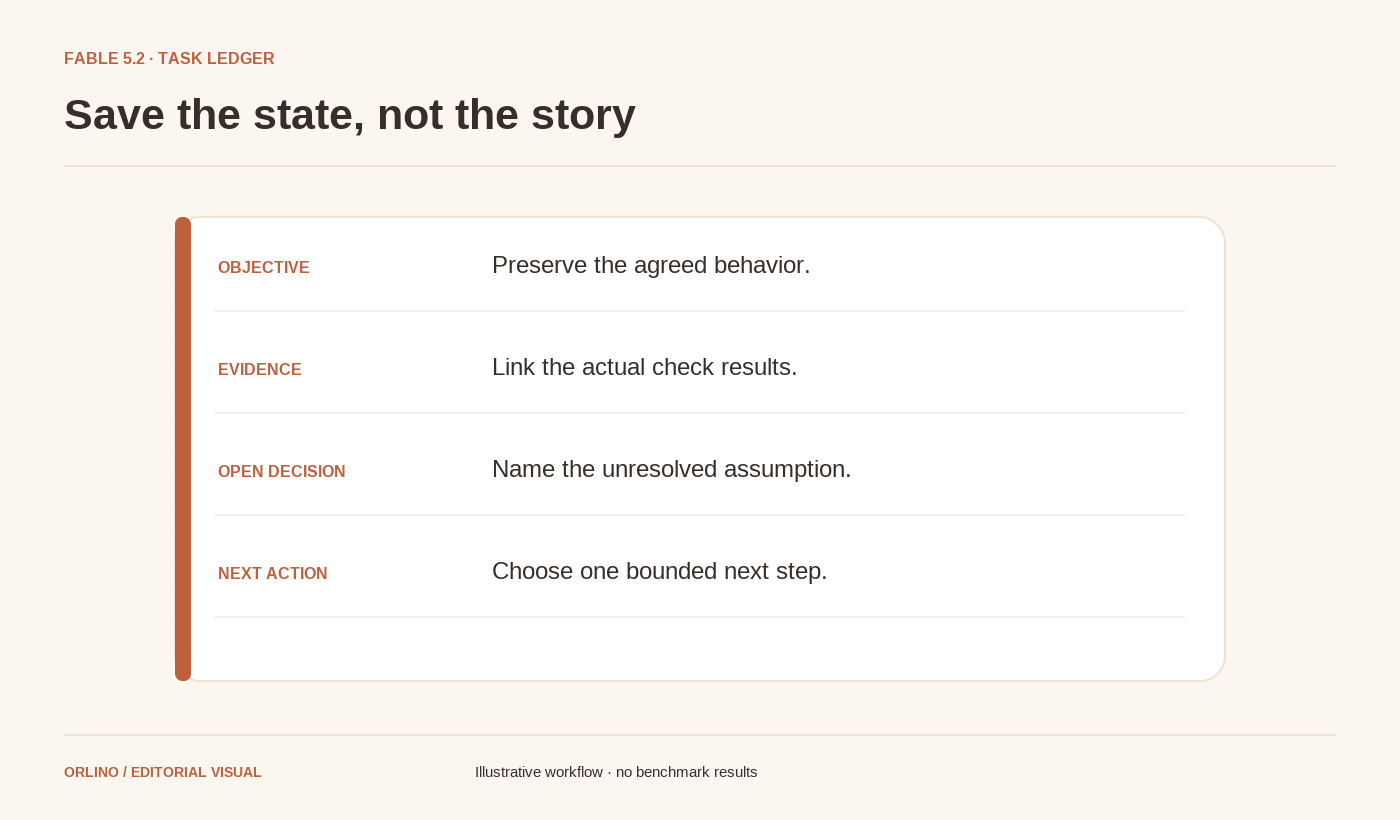
Use a small ledger to connect decisions with evidence. The ledger can live in a Markdown file beside the working notes. Keep it short enough to review at every checkpoint, and retain links to larger logs rather than copying every tool response into it.
| Ledger field | Example for the reporting task | Why it matters |
|---|---|---|
| Objective | Replace date parser without response changes | Prevents scope drift |
| Current state | Parsing call sites mapped | Makes progress resumable |
| Open decision | Handling an undocumented null input | Exposes uncertainty |
| Evidence | Test output and relevant file locations | Supports review |
| Next action | Implement one adapter and test boundaries | Limits the next step |
| Stop condition | Public behavior would change | Protects the task boundary |
Keep completed decisions separate from assumptions. “The export client uses UTC” might be an assumption discovered during exploration. It should become a verified decision only after the relevant code or documentation has been inspected. When evidence contradicts it, update the ledger and identify which completed steps need another look.
Divide the assignment by risk and dependency
A checkpoint belongs where the next action becomes more expensive to reverse. Mapping call sites is a good first phase because it informs the implementation. Replacing a shared parser before that mapping is complete may spread a mistaken assumption across several modules.
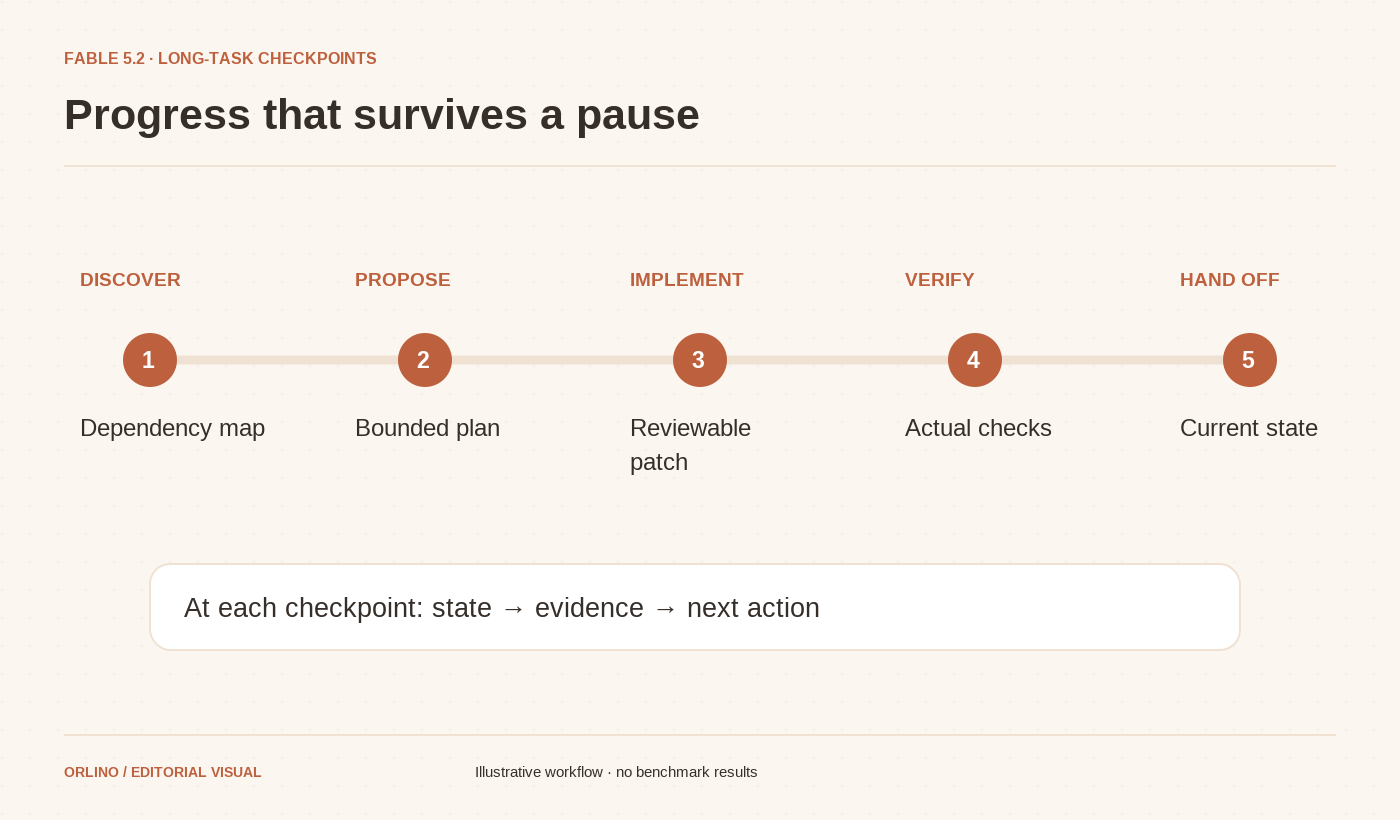
A useful sequence is discovery, a small proposal, a constrained implementation, verification, and a handoff. Each phase produces a reviewable artifact. Discovery produces a dependency map. The proposal identifies the interface and compatibility decisions. Implementation produces a patch. Verification produces commands and results. Handoff explains the final state and remaining limits.
Avoid dividing work into arbitrary equal-sized chunks. Ten files do not necessarily represent ten independent tasks. One configuration file may affect every service, while several test fixtures may be isolated. Group work around behavioral boundaries and dependencies so that a failure can be localized without reconstructing the whole assignment.
Use the Fable 5.2 pricing guide to budget for repeated context, retries, and the complete accepted task.
Give the agent a checkpoint prompt
A checkpoint prompt should ask for a state update that another person or session can use. It should not reward the appearance of activity. A long list of tools called tells a reviewer less than a short explanation of what changed and why it meets a requirement.
Continue the date-parser migration within the approved scope.
At each checkpoint, report:
1. Files changed and the behavior each change addresses.
2. Acceptance checks run, with actual results.
3. Assumptions confirmed or rejected.
4. Open questions and the next bounded action.
Stop if a public response contract must change.
Do not mark an unrun check as passed.
Store the brief and ledger outside conversational memory when the environment permits it. A persistent artifact reduces the cost of resuming after a session interruption. Still inspect the workspace on resume: a saved summary cannot establish that files have remained unchanged.
Keep tool permissions aligned with the phase
Discovery generally needs read access and limited inspection commands. Implementation needs permission to edit the relevant project files. Deployment is a separate operational step with its own consequences. Treat these as capabilities granted by the application or environment, rather than intrinsic properties of the model name.
For the reporting example, the task may authorize edits and local checks while excluding database migrations and production changes. If a later step needs a new permission, prepare the concrete change and explain its purpose. This makes the request reviewable and prevents an open-ended authorization from replacing a specific decision.
Tool responses are evidence to interpret. A successful command exit does not automatically prove the business behavior. A test runner may execute no tests because a path was wrong. The checkpoint should include enough context to show which cases were exercised, and any skipped or unavailable checks should remain visible.
Recover from failure without repeating the whole task
When a tool fails, first determine whether the failure changed state. A read timeout and a partially applied edit require different recovery actions. Repeating a mutation without inspection can duplicate work or overwrite a valid result. Check the filesystem, command output, or application state before deciding what to retry.
Record the smallest useful failure summary: intended action, observed result, current state, and proposed recovery. If a test fails because the environment lacks a dependency, do not describe it as evidence that the patch is incorrect. Conversely, do not classify a real behavior failure as an environment issue merely because fixing the environment would be inconvenient.
A retry budget can help keep investigation bounded. The budget should specify when to change strategy or ask for a decision, rather than encouraging repeated attempts at the same command. For example, after two reproducible failures in an external service, continue independent local work and document the blocked integration check.
For an analytical deliverable, the Fable 5.2 data-analysis workflow shows what a reproducible verification stage can contain.
Resume from evidence, not a confident summary
A good resumption starts by reading the task brief, the latest ledger, and the relevant current files. Then compare them with the last known state. Look for new commits, changed dependencies, generated files, or edits that arrived from another contributor.
Suppose a colleague changes the reporting API while the agent is paused. The existing adapter may still compile but no longer meet the new contract. The correct response is to identify the new dependency and revise the plan, rather than continuing the previous checklist mechanically. State transitions matter more than preserving the appearance of uninterrupted progress.
Keep the original acceptance criteria visible during the resume. New information can justify a revision, but revisions should be explicit. Otherwise the task can quietly become easier: a failing edge case disappears from the summary, and the final report looks complete because the definition of completion changed.
Evaluate the completed workflow
Measure accepted work rather than session duration. Useful observations include whether the final artifact satisfies each criterion, how many material corrections the reviewer requested, whether the handoff reproduces the checks, and how much intervention was required. These are observations from your own trial, not general claims about Fable’s performance.
Use the same task and environment when comparing another model. The Fable 5.2 vs Opus 5.5 guide explains how to keep the comparison interpretable. A stronger configuration may consume more time or tokens; a lower-cost configuration may require more retries. The useful unit is the accepted deliverable, including review and recovery.
For repository work, pair the long-task ledger with a focused code-review process. The ledger shows how the work progressed; code review checks whether the resulting patch introduces concrete defects. Neither artifact substitutes for the other.
Prepare a handoff that makes limits visible
The final handoff should describe the resulting behavior before listing implementation details. Include the changed files, the acceptance checks and their actual outcomes, and any unresolved compatibility or environment limits. Link to larger logs only when they help someone reproduce a result.
A useful handoff also states the next operational action. A completed local patch may be ready for review while deployment remains outstanding. Naming that state precisely prevents “finished” from meaning different things to the author, reviewer, and operator. Avoid adding an automatic production action simply because the implementation phase succeeded.
If a requirement remains unmet, identify it plainly. A well-documented partial result is easier to continue than a confident completion claim that conceals missing checks. The goal is a task that survives interruption, review, and transfer without forcing the next person to reconstruct its history.
Conclusion
Use Claude Fable 5.2 for long tasks with a durable brief, a compact ledger, and checkpoints placed around meaningful changes in risk. Let each phase produce evidence that supports the next action. Evaluate the final accepted artifact alongside the cost of review and recovery. The Fable 5.2 model guide provides the broader capability and access context for setting up that trial.
FAQ
Can Fable 5.2 work on a task for several hours?
Anthropic describes long-horizon agentic work among its intended uses. Actual session length and available tools depend on the product and environment. Structure the assignment so that progress can be inspected and resumed, rather than assuming uninterrupted execution.
What should a checkpoint contain?
Include the current state, changed artifacts, actual verification results, unresolved assumptions, and the next bounded action. Keep raw logs elsewhere when they are too large to review comfortably.
How often should checkpoints happen?
Place them at dependency and risk boundaries: after discovery, before a broad change, after a meaningful implementation step, and before handoff. The right interval depends on how expensive an incorrect next action would be.
Does a large context window replace task notes?
No. Context capacity describes how much information the model can process under the relevant conditions. A durable brief and ledger also help people review the work and let a later session verify the current state.
What happens when the agent is interrupted?
Resume by inspecting the saved brief, ledger, and current workspace. Reconcile changes before continuing. A previous summary is useful orientation, but it should not be treated as proof that the workspace is unchanged.
Should the agent automatically retry failed actions?
Inspect the result first, especially for actions that modify state. A retry can be appropriate after a transient failure, but repeating a partially completed mutation may create additional problems.
How do I know the task is complete?
Check the agreed acceptance criteria against the final artifact and recorded evidence. Explain any unrun checks or unmet requirements. Completion should follow the defined result, rather than elapsed time or the number of steps performed.