


Claude Fable 5.2 is worth evaluating when your task involves several connected decisions: understanding an unfamiliar codebase, choosing an approach, using tools, checking the result, and revising work that falls short. The useful question is whether it can complete that workflow to your acceptance standard—not how impressive its first answer sounds.
Anthropic introduced Fable 5.2 on November 9, 2026, for demanding technical and knowledge work. Its official product page describes a focus on complex coding, extended agent tasks, and analytical work. Those are the developer's claims; they do not establish how it will perform on your project. Anthropic's Fable page.
For a practical evaluation, choose one difficult but reviewable task and define what a finished result must contain.
Provider specifications
| Property | Provider specification |
|---|---|
| Claude API model ID | claude-fable-5-2 |
| Context window | 1M tokens |
| Maximum output | 128K tokens |
| Inputs → output | Text and images → text |
| Listed input / output rate | $8 / $40 per million tokens |
| Thinking | Adaptive, always on; effort is configurable |
Checked November 11, 2026. Official Fable 5.2 reference. Rates shown are provider references, not Orlino prices.
What kind of task should you give Fable 5.2?
Look for work with a clear output and several dependencies. A good coding example is investigating a recurring import failure, identifying the cause, preparing a patch, and explaining how the patch was checked. A good knowledge-work example is reconciling conflicting source documents into a decision memo.
A request such as “make this system better” is hard to evaluate. A more useful request identifies the outcome, the available evidence, the limits of the assignment, and the checks that matter.
For example, you might ask for a migration plan that must preserve existing interfaces, identify affected components, and separate verified requirements from unresolved questions. That gives both the model and the reviewer a concrete target.
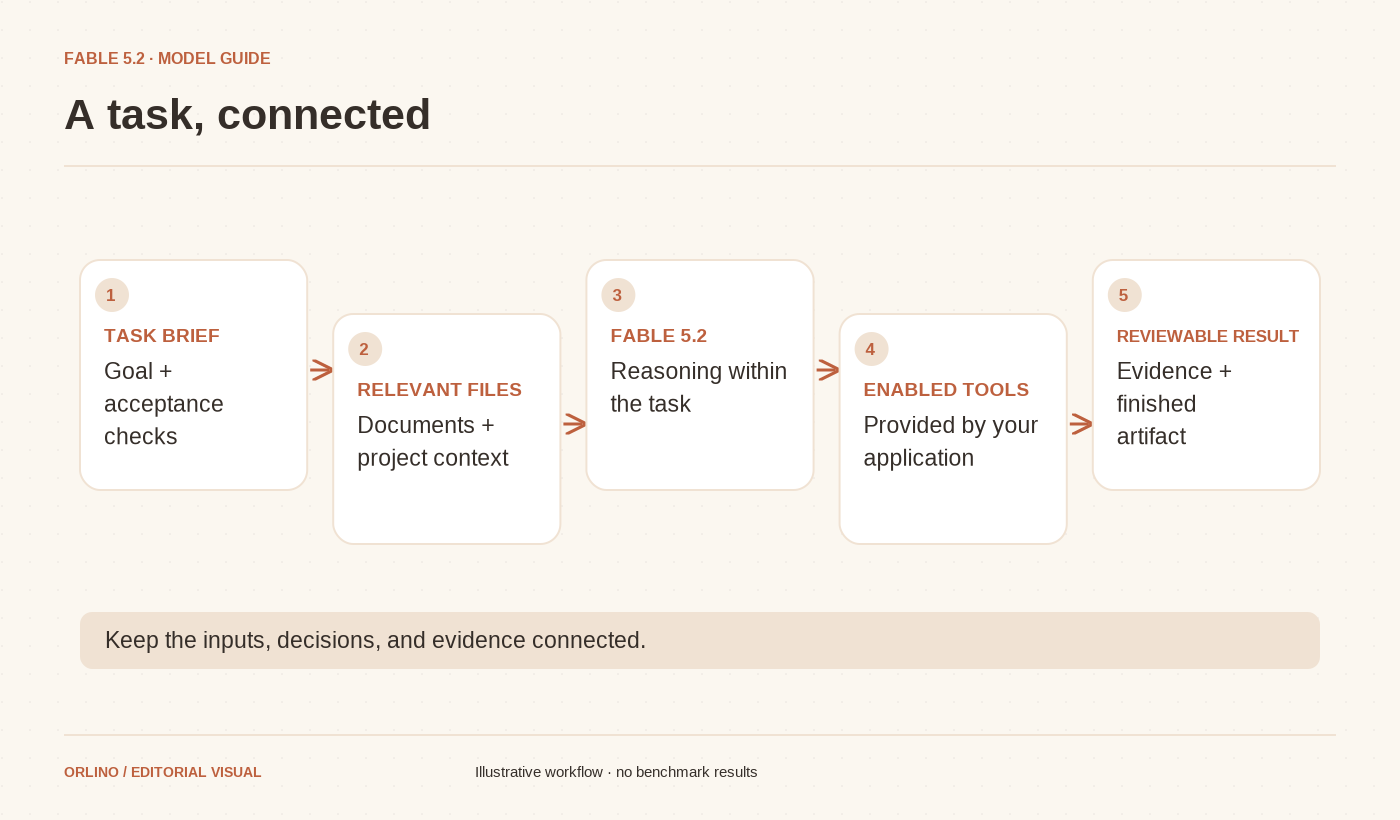
Start with a task handoff, not a long conversation
The following is an illustrative prompt template. It is a suggested evaluation method, not a record of a completed Fable test.
Goal: Diagnose why this import job fails on files with missing fields.

Available materials:
- The relevant source files
- A redacted failing input
- Existing tests and the error output

Constraints:
- Preserve the public interface.
- Do not change unrelated modules.
- Ask before any production or external-system action.

Deliverables:
1. Explain the likely cause and cite the relevant code.
2. Propose the smallest reasonable fix.
3. Run the available checks and report their results.
4. List anything that remains unverified.
This structure makes the response easier to inspect. You can distinguish a diagnosis from a guess, a proposed change from an executed change, and a passing check from an unsupported claim.
For repository work, use the Fable 5.2 code-review guide to turn a proposed defect into a reproducible finding.
Build checkpoints into longer work
Long tasks benefit from intermediate evidence. Before allowing a broad implementation, review the diagnosis and intended scope. Before accepting the result, review the changed files and the checks that were actually run.
For document work, use the same principle. Ask for a source inventory before the report, a list of unresolved conflicts before recommendations, and a final trace from important claims back to the supporting material.
An additional model-generated review can identify questions to investigate, but it should not replace independent checks. Re-run relevant tests, open cited documents, or verify calculations using the original inputs.
How does Fable 5.2 API access work?
Anthropic lists claude-fable-5-2 as the Claude API model ID and describes access through its platform and supported cloud channels. The access route matters: a consumer subscription, direct API usage, and a third-party application can have different billing and usage conditions. Anthropic's availability information.
Before integrating it into a workflow, confirm the model ID, your account's access, the tools your application exposes, and the permissions those tools receive. A model's capabilities do not automatically give an application access to your files, browser, or business systems.
For an initial evaluation, use a controlled workspace with representative inputs. Keep the task small enough to review before expanding the scope.
For spreadsheet or CSV work, the Fable 5.2 data-analysis workflow explains how to validate row grain, joins, and denominators.
Measure the result that matters
A useful evaluation record includes the completed deliverable, errors found during review, total usage cost, elapsed time, and the manual work still required.
For the import-job example, a convincing result would include a reproducible failure, a relevant change, meaningful checks, and an explanation of remaining uncertainty. An eloquent answer without those artifacts should not receive the same assessment.
For a decision memo, inspect whether the report distinguishes evidence from inference and acknowledges information that could change the recommendation.
Understand the model, the application, and the tools
Three parts of an AI workflow affect the result. The model interprets the request and generates responses. The application manages the conversation, files, and available settings. Tools let the application retrieve information or perform actions. Evaluate those parts separately when deciding how to use Claude Fable 5.2.
For example, giving a model a code excerpt is different from giving an agent access to a repository and a test runner. The first setup can discuss a patch; the second may be able to prepare and check one. A response that describes a command does not establish that the command was executed.
Write down what your environment can actually do before the task starts. For coding work, that might include reading files, searching the repository, editing a branch, and running selected checks. For research, it might include opening supplied documents and retrieving public pages. Keep the permissions aligned with the assignment so the evaluation remains understandable.
When an assignment spans several sessions, the Fable 5.2 checkpoint workflow helps preserve decisions and execution state.
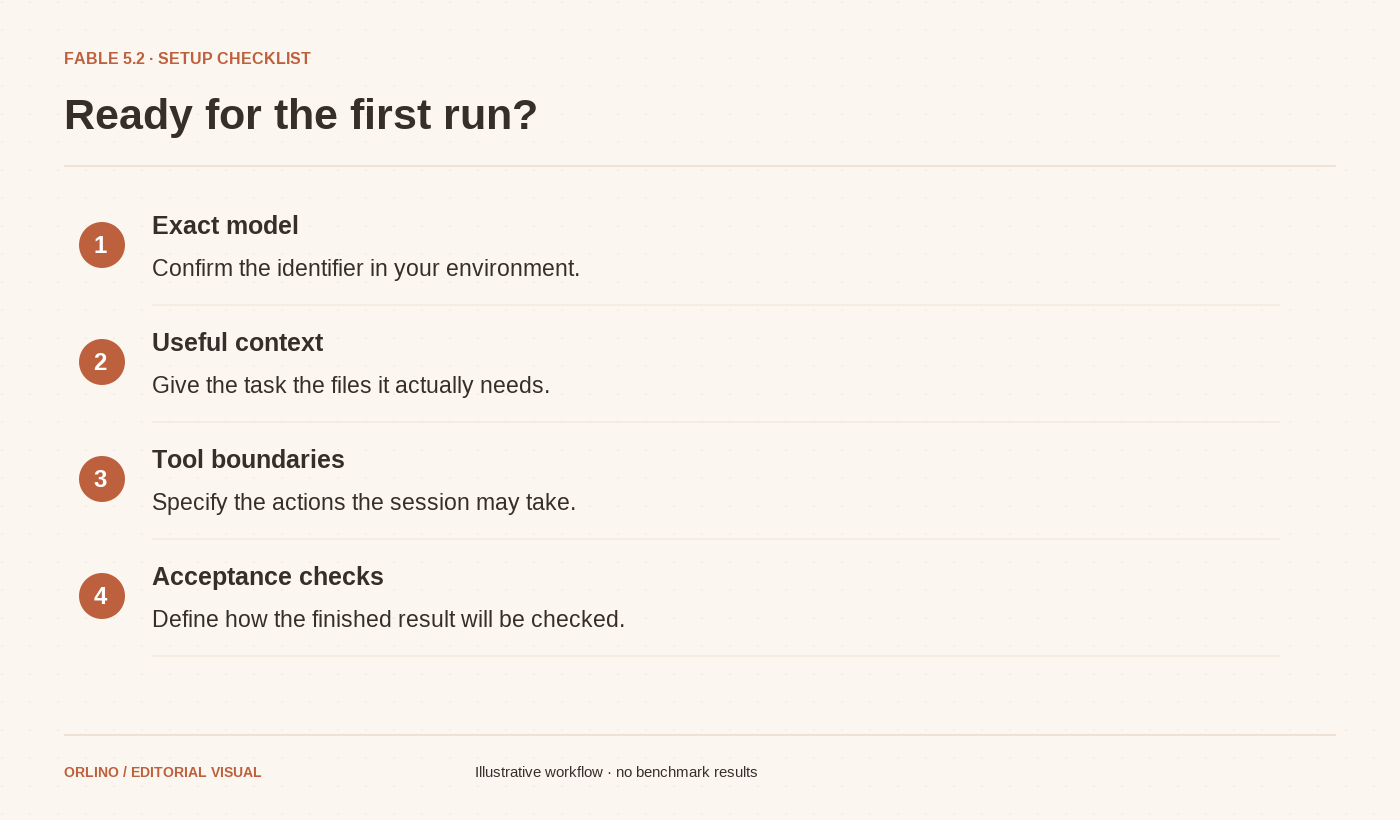
What the published specifications mean in practice
The Fable 5.2 documentation lists a 1M-token context window, a 128K-token maximum output, and text-and-image input with text output. It also describes always-on adaptive thinking, controlled through the effort parameter. Fable 5.2 technical overview.
A context limit is a capacity specification. It does not remove the need to select relevant material. A repository dump containing obsolete files, generated assets, and unrelated discussions can make a task harder to inspect even when the material fits.
Prepare a short orientation document: what the project does, where the relevant code or evidence lives, which constraints are binding, and which assumptions are uncertain. Then provide the supporting files. This gives the reviewer a way to check whether the model worked from the intended materials.
Similarly, a high output limit should not become a request for a long answer. Ask for the artifacts the task requires: a patch, a test report, a migration checklist, or a decision memo. A concise deliverable with usable evidence is easier to maintain.
Example workflow: investigate a failing data import
Imagine that a data import succeeds for some customer files and fails for others. This is an illustrative task design, with no claimed test result.
Begin by preserving the original failing input and recording the expected behavior. If a missing optional field should produce a blank value, make that requirement explicit. If malformed records should be rejected, define the error the caller should receive.
Next, ask Fable to trace the input through the relevant functions and identify where the actual behavior diverges from the requirement. Request the location of the suspected failure and a proposed way to reproduce it. Review that explanation before allowing a broad implementation.
After the diagnosis, ask for a focused change and checks that exercise the behavior. A useful set might include a valid record, an omitted optional field, an invalid required field, and a repeated import. The appropriate cases depend on the system; they should test the requirement rather than merely repeat the new implementation.
Finally, inspect the work as a package. Can another developer reproduce the original problem? Does the change address that problem? Which existing behaviors were checked? What could not be verified in the available environment? This sequence turns an open-ended coding request into a reviewable engineering task.
Before scaling a recurring workflow, use the Fable 5.2 pricing guide to estimate its complete usage.
Example workflow: reconcile conflicting documents
For a knowledge-work assignment, suppose two internal documents disagree about a delivery requirement. Provide both documents with their dates and owners, if known. Ask for the exact points of disagreement before requesting a recommendation.
A practical output has three parts: a table of claims and source locations, an explanation of what the disagreement changes, and a list of questions that require a decision from the responsible person. The model should preserve uncertainty when the supplied material cannot resolve it.
This approach is useful when the goal is a decision memo rather than a general summary. A summary can repeat both claims without addressing their conflict. A decision memo needs to explain why the conflict matters and what evidence or authorization would resolve it.
If you already use Opus, the Fable 5.2 vs Opus 5.5 comparison provides a more focused evaluation plan.
Diagnose an unhelpful result before retrying
If the first result misses the goal, identify the failure precisely. “Try harder” gives little direction. “The diagnosis does not explain why the same file succeeds on a second run” points to a specific gap.
Common corrections include supplying a missing example, narrowing an ambiguous requirement, restoring an omitted constraint, or making the output format easier to check. Ask the model to revise the affected reasoning and work, then repeat the relevant verification.
Stop and redesign the assignment when successive attempts depend on the same unsupported assumption. A useful next step may be gathering a missing log or asking a stakeholder to clarify the requirement. That can improve the workflow more than another unstructured model call.
Keep an operating record for repeatable tasks
Once an assignment works, save the reusable pieces: the task template, source-selection rules, permitted actions, acceptance checks, and final deliverable format. Preserve the model and configuration used for the evaluation.
For a repeated report, record the input period and data definitions. For a coding workflow, record the repository state and commands. When the task changes, update the relevant parts of the record so an older success does not become evidence for a different process.
When should you choose another model?
Use a simpler workflow when a task already has an obvious procedure and a reliable, easy-to-check output. Routine formatting, short extraction tasks, and straightforward rewrites may not justify moving to a more expensive model.
Anthropic recommends starting with Opus 5.5 for most workloads and considering Fable 5.2 for harder reasoning or extended agent work when evaluations justify it. Claude model overview.
Your own acceptance criteria should decide the escalation. If the existing model already delivers a correct, reviewable result at an acceptable cost, there may be little value in changing it.
Is Fable 5.2 available in every AI workspace?
Check the exact model listing in the application you plan to use. A workspace that offers Claude models may expose a different version or a different set of tools.
For a starting point when comparing workflows, explore Orlino's AI model overview. Confirm the available version and supported tools before planning a task around a particular model.
Conclusion
Claude Fable 5.2 is most useful to evaluate through a complete assignment with an observable result. Give it the necessary materials, define the allowed scope, and make the acceptance checks explicit. For coding work, that means connecting a diagnosis to a change and meaningful verification. For knowledge work, it means connecting conclusions to evidence and preserving unresolved questions.
Begin with one representative task before expanding the workflow. Keep the result, usage record, and review findings so you can decide whether Fable adds value for that type of work. Confirm the model version and available tools in the application you actually use, then judge success by the finished deliverable.
FAQ
What is Claude Fable 5.2?
Claude Fable 5.2 is an Anthropic model positioned for demanding reasoning and extended agent tasks. Its official overview includes technical work and research-oriented uses. Evaluate that positioning against a task you can independently review; it is not a guarantee that any particular assignment will succeed. Official model overview.
Is Claude Fable 5.2 the same as Claude Code?
They describe different parts of a workflow. Fable 5.2 is a model; Claude Code is a coding product that can provide a model with tools and project context. Check which model your coding environment is using and what actions it can perform before comparing results across interfaces.
Can Fable 5.2 work with an entire repository?
That depends on the application, its repository access, and the materials supplied. Define the relevant directories, constraints, and checks instead of assuming every file will be useful. Inspect which files were actually considered and whether the final change addresses the stated requirement.
Does a long context window guarantee accurate analysis?
No. Capacity and correctness are separate questions. Relevant evidence can still be overlooked or interpreted incorrectly. Use a source map, ask for references to important code or documents, and verify the claims that determine whether the result is acceptable.
How should I estimate Fable 5.2 API costs?
Use the applicable current rates and the full usage from the task, including retries and any separately billed tools or processing options. Treat a short trial as a measurement of that setup. An app subscription or third-party service can have a different billing model. Official Claude API pricing.
Is Fable 5.2 suitable for routine writing tasks?
You can evaluate it, but a more capable model is not automatically the most economical choice for a simple request. If an existing model produces an acceptable result with little correction, compare the added value before moving routine work to a more expensive setup.
Can I use these prompts in Orlino?
The task-handoff structure is a general workflow template. Check Orlino's current model selection, file access, and available tools before using it for a particular assignment. The presence of Claude models in a workspace does not confirm access to Fable 5.2 specifically.